Friday, August 8, 2014

Return to Caracas #1


Our beloved tequenos at the Tamanaco Hotel, Caracas
We returned to Caracas for our final week in Venezuela. We were hoping to meet with members of El Sistema senior management, members of the team responsible for research, evaluation, and formulating a plan for a new higher education institution, whilst also visiting the Simon Bolivar Conservatory. Unfortunately, as it was the week of municipal elections, the nucleos and the conservatory were closed (luckily we didn’t miss out as much as the last class of Fellows when Chavez died).

There are 250 staff (all Venezuelan) working at the head office of the Foundacion which runs El Sistema. We were able to meet with three out of the five members of senior management – Eduardo Mendez (Executive Director ), Valdemar Rodriguez (Deputy Executive Director) and, to our great delight, Dr. Abreu (Founding Director).

l to r: Tony Woodcock, Dr. Abreu, Leslie Wu Foley, Eduardo Mendez
First was the unassuming and utterly inspiring Eduardo Mendez. Eduardo grew up as a violinist in El Sistema, and is now head of the administration and management side of the program. He is one of the few who receives a lot of personal time and assistance from Dr. Abreu. For the first time we made our way to the buildings of the Fundamusical. He talked to us for about an hour, giving us more of an overview of the program and its goals rather than the details of how each nucleo operates that we had been concerned with so far doing our visits. Out of his discussion came three main themes of how he sees El Sistema: a different methodology, breaking boundaries and the importance of the El Sistema family.

A different, but not necessarily better methodology

Eduardo echoed many voices we heard that emphasised that El Sistema is not a musical ‘miracle’ but a result of many people working hard to serve the students together. He asked us to imagine how many teachers/hours/instruments would be needed to teach every child in the nucleo in the traditional Western methodology; “We would still be working on generation one!”

It was interesting to hear his summary of how El Sistema works: The program is based on collective teaching where private lessons do happen. This makes the process of teaching simpler but more time-consuming – students obviously progress more in four months with four hours of teaching a day than they would in one year. Teachers surround the students all the time, so they can feel that they are getting better every day and progressing quicker. In addition they are not getting bad habits at home that have to be dealt with, the students are motivated by participating in concerts on Saturdays and they experience the pride of their parents seeing them in uniform and receiving applause for their work. He also talked about taking advantage of the pace at which children can learn when they are young – he pointed out how a nine month old can learn how to use an IPad, and how that potential can lead to a performance of 7-12 year olds in the National Children’s Orchestra in Salzburg! (Eduardo was 17 when he played Mahler 1 to audition for the Simon Bolivar Youth Orchestra, now it is used for preparation for National Children’s Orchestra.)

“We achieve precise, clear and direct objectives, using passion, motivation and methodology.” His challenge is to break down this passion and joy to the ground and make it work like a business, so that they can be as efficient as possible with the resources they have, serve as many children as possible and continue to serve the community with up to five concerts a week (in Caracas).

El Sistema applies and replicates its own methodology to facilitate the growth of the program and see more children served, but he pointed out the different motivations behind this to the way that Europe, North America and Asia see the nurturing of musicians; the major difference being the dual focus of community-building as well as the development of young musicians.

“We are here to provide opportunities for everyone, students and the audience who will become your allies for funds and networks. Communities are then built surrounding a common objective. Our objective is not to produce professional musicians, but our goals are to serve the needs of children and youth through music. We seek to get the most amount of children in the project – this is when we are helping to create a new human being. We still have a lot to learn as a community builder but all skills can be applied to help others. We are creating a new concept or ecology. The challenge is convincing the world that it is not better but different. A great example is that the very traditional New England Conservatory wants you to be here!”

Breaking barriers

Another striking feature of El Sistema is the focus on pushing boundaries – the sheer amount of students involved, the number of concerts occurring every week, the inclusion we have seen in the Special Needs programming and above all the expectations of what the students are capable of. The best example of this is the 1500 El Sistema students performing at the Salzburg Festival for three weeks; five programs of non-professionals performing as professionals at the highest level possible, and all the tickets were sold out six months before.

Of course the Simon Bolivar project will be continuing the massive expansion of the program, and Eduardo is instrumental in decisions determining how many more children are added to the program each month and in which city, the taking over of schools and community spaces, and expanding existing nucleos (although on our visits many seem to be already at bursting point with long waiting lists!)

El Sistema is now breaking the boundaries of the Venezuelan borders and inspiring many programs globally. Eduardo remarked that in 1975 Dr. Abreu told his students that their orchestra would take over the country with music and the world will look to Venezuela and want to imitate you. This prophecy is coming true, and following in this quasi-religious perspective, Eduardo stated that the work will be finished when all countries can do this work.

The Family

The sense of responsibility for the students and their well-being was a very common theme from the teachers and El Sistema leaders; “The program is the closest thing children have to family, they call the nucleo director or teacher when something is wrong”. In this way, strong emotional connections are created and the students become an integral part of El Sistema and how it functions: “they identify themselves with the program as they achieve results, human results and feel transformed as they enter the orchestra or nucleo – the principle objective of all this.”

Finally, Eduardo’s message to the Sistema Fellows – “You are part of the network, our achievements you should take and build on and vice versa; we are a group. This is free and you should feel part of the El Sistema family. Transmit this to all you will work with. Always believe in what you saw in Venezuela.”
 

Saturday, August 2, 2014

Merida #3


Fe Y Alegria

Fe y Alegria (Hope and Joy) school is in a stunning location up in the mountains outside Merida. There are 500 children in this nucleo in a relatively poor area, and this nucleo is a rare example in El Sistema of an in-school program, in this case at a Catholic school (kindergarten until 6th grade). The wife of Jésus Perez is the director here. She explained that the students come from different socio-economic backgrounds, and that it is a cheap and accessible school for families in the mountains.

Currently, every student participates in music lessons once a week which includes two hours of private lessons and choir in the morning, two hours of ensembles and orchestra in the afternoon. In addition there are music theory classes. There is a core group of teachers which is supported by additional staff in the afternoon.
There was a similar project in the area at another Catholic boarding school, run by a nun who is a friend of Dr. Abreu. She asked for the program to be set up at the school, but it only existed for five years before being moved to Fe Y Alegria. Other clubs and distractions lead to low student retention and interest. It was not often that we heard of a failed nucleo in our visit to Venezuela. There are still opportunities to participate in music activities at the school as "El Sistema doesn’t ever close its doors on students". They were at the old school for two years without instruments - teaching choir, music theory and sharing twelve recorders! It has been  six months only since the move to the new site, which provides more space and offers less additional activities.

We could hear students practicing constantly whilst we were talking during the school morning break. It turned out that they were preparing for an audition that day to perform in an upcoming presentation. Auditions had to be held as there weren't enough instruments for everyone to participate. They were also going to starting the children’s and youth choir that very day. Again we heard the Merida Maxim of 'listening and experiencing before theory' as they talked about setting up the new project at the school. 
We enjoyed taking a tour of the school and engaged some classes in the orchestra song Tatjana had taught us, whilst for the younger kids we performed Tucheze Tanzania!


Sunday, July 20, 2014

El Sistema Fellows 2014 Graduation 16th May

The graduation of the 2014 cohort of El Sistema Fellows took place at the New England Conservatory on 16th May. The ceremony also heralded the transition between the end of the Fellowship Program to the Sistema Fellows Resource Center (see previous posts). It was a great way to end a fabulous year: we were able to celebrate the bonds and friendships we had formed by sharing tributes to each other and a multitude of in-jokes.

Read the write-up of the event on the TED Prize blog:

http://blog.tedprize.com/how-50-music-teachers-are-creating-5000-musician-citizens-across-the-us-thanks-to-a-ted-prize-wish/


Saturday, July 19, 2014

Merida #2

 The system of orchestras within the Merida nucleo

Paper Orchestra – At this nucleo, teachers are responsible for making the instruments, they sing and imitate playing with the students and also demonstrate how to care of the instruments. They again emphasised the approach of 'Play first than read'! As with Suzuki's philosophy of music learning, they compared the process to first knowing how to speak, then read and write language.

Pre-Infantil – After six months of learning on an instrument, the children start in a beginners orchestra. Typically they spend 1 hour 30 mins each day rehearsing, and start a new orchestra with more complex repertoire each year. There is the creation of new beginners orchestra every school year (we saw many orchestras who have been playing for six months as we visited halfway through the academic year).
Infantil - In these rehearsals we were able to observe the role of sectional tutors in a full rehearsal: standing and pacing around the players of their section they mimic bowings, count aloud, help to maintain tempo, remind the children of technical details, relay & explain instructions from the conductor, tune & fix instruments, keep discipline and silence. The focus of all of this constant advice was the main principle of learning to play together – speed, expression, rhythms, etc.

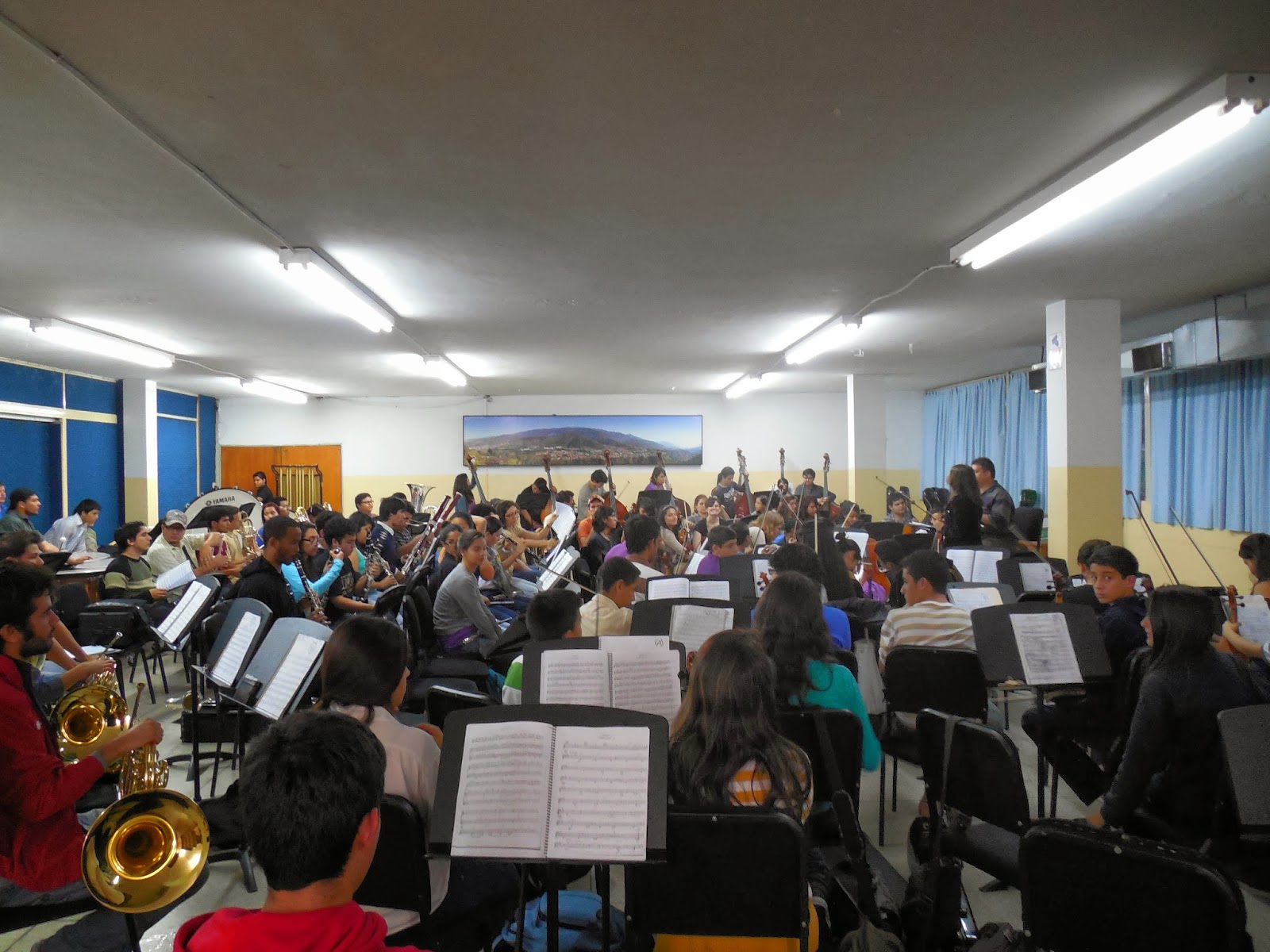
Juvenil - The youth orchestra rehearsal was an incredible experience. The force of the sound of was as overwhelming as the orchestras in the nucleos in Caracas that we had visited. I decided to borrow a violin to experience being a part of one of these youth orchestras (it had been ten years since I had played the violin in an orchestra). The choice of repertoire was not kind to me, the 4th movement of Shostakovich's 5th Symphony 4th movt and Silvestre Revueltas' piece Sensemaya with rhythms that are almost impossible to sightread. The conductor of the Infantil orchestra, Joel Perez, came to my aid and sat down next to me at the back of the second violins section. The support that I saw being given to the children at the previous rehearsal, was now being given to me. Especially in the Revueltas piece that I was not familiar with, Joel counted aloud, sang the rhythms of the percussion section that I would soon join in with, and helped me to negotiate some terrible photocopied scores with pages missing! I found myself watching the bowing of the players in front of me, trying to keep up rather than feeling confident enough to watch the conductor - I was out of my comfort zone musically again. I think I managed about half the notes required of me, but I gained a sense of what it must feel like for a lot of the students who are being constantly challenged in this learning environment.

I was interested in the progression of the students through the different levels of the orchestra. My own experience has involved a more rigid system - we think more of progress on the scale of the individual e.g. this musician has reached a certain technical level and is ready to audition for the next orchestra up. Instead, in many nucleos they follow the progress of the group of children and make the call as to whether the group is ready to tackle more advanced repertoire, thus keeping the community of students together as much as possible. They simply change the title of the orchestra from Children to Youth.

It seems that the change in repertoire tackled is the most defining element of the identity of the new orchestra, for example the children know that if they are starting to learn Tchaikovsky's 4th and Shostakovich's 10th symphonies that they are at the next level. There are auditions as well, for the players at the first stand for example. They evaluate the players every week and change the section leaders every six months. There were auditions for the chance to go to Salzburg and for orchestras in Caracas. Many students were preparing for auditions when we were there - an El Sistema favourite, the 4th movement of Tchaikovsky's 4th symphony was chosen as audition material, a piece of popular shared repertoire that everyone wants to participate in.

As I have mentioned before, the orchestral repertoire used is unified throughout the nucleos, so students have a clear idea of what level they are working at according to what pieces they are rehearsing. Also they have seen their peers and those before them model playing the same pieces and the community is familiar with them. How much of this approach is strategic or needs-based according to the resources available? Do students (and teachers) find the same repertoire being repeated each year and for each ensemble ultimately uninspiring? How much of the repertoire involves flexibility to community interests? Again it also seems that there is a problem in retaining students from the Pre-Infantil orchestra onwards, otherwise there would be an immense amount of students in the Juvenil orchestra if a new cohort is formed every year.


Kirstein & Amelia Combrink 31st May 2014

A short break away from blogging and a name change...


Saturday, April 26, 2014

Creative Connections #3


Creative Connections #2


This year's course in a nutshell:

Participants:

Creative Leadership Team from Guildhall, Peabody Conservatory Students, El Sistema Fellows, City Neighbours High School (about 7 kids), Booker T Middle School (20 kids, choir and band), LB Jazz Band (15 middle schoolers), New Song (30 K&1st graders), HEMS (20 1st graders), MAWES (20 1st graders), Tchaik strings (18 1st -?graders).

Inspiration: Colours
Process: Launch event, daily composing sessions, dress rehearsal and two concerts


The Fellowship has been an incredible space to reflect on how music can create social change. Collectively, we have thought a lot about the merits of ensemble-based learning, intensive study, community engagement, peer teaching and other concepts that would make music education a more democratic and social experience. How can we encourage ownership, personal agency, and motivation in a world where the master-apprentice, maestro-orchestra model is predominant?

More recently, it has been our visits to projects in other disciplines in the arts that have struck us as being so engaging, full of vibrancy, vitality and utilising the student’s experiences in the world they live in. Essentially, it is the balance between creating and re-creating, engaging with different styles, genres and world traditions where the music education world can be inspired by others in the arts.

The experience of the Creative Connections course, fed into all of these thoughts and more. The atmosphere created is accepting of all musical genres and backgrounds, and participants have the delight of being a ‘musician’ first and foremost. Others expressed the same feelings I was experiencing of being rejuvenated and reinvigorated as a musician - put back in touch with our innate creativity and drawing on our own musical history.

As a general music teacher, I have done a fair amount of composing with young children using a variety of starting points but this project was so different in many ways. Being outside of the classroom freed all the participants from adhering to expected outcomes, created an informal atmosphere and removed the pressure and stress on the students. The process also allowed me to see how a teacher can work more as a leader or facilitator in a very effective way, and lessen the distance between teacher and pupil. It requires a deal of faith and a huge amount of expertise to allow such a process to happen without a detailed structure, and yet to combine so much material to end up with a high quality piece.

During the composing sessions, there was also great sense of trust in the students from the creative leadership team who waited patiently for ideas to arrive, and for participants to gain the confidence to share them. All and any material provided by the students was positively received and used as much as possible in the final piece. The composing process encouraged participants to follow their immediate feelings and gut reactions, without having to explain and overly discuss their thoughts. Those who have had conservatory training in composing mentioned the stark contrast between the ‘over-thinking’ they are used to and attending to intuitive responses and spontaneous reactions that was involved in this process.

El Sistema Fellows in the past have talked about encouraging a multiplicity of roles as a musician; citizen, artist, teacher and scholar. The Creative Connections experience has added the additional roles of composer, improviser, facilitator, rapper and dancer! I now can’t imagine being a music educator without encouraging all of these roles in my students, and I am excited by the possibilities of the musical boundaries that will be pushed by trusting in the immense creativity of children and youth. Most importantly, by involving students, parents and leaders in the same process, the community was brought together in a powerful way, and the end result celebrated the diversity and musical expressions of the participants.