Thursday, December 10, 2015

Home Assignment in Cape Town

Kirstein speaks at Bellville Uitsig NG Kerk, Cape Town
The Combrink trio are now safely in Cape Town as we look forward to Christmas and New Year with Kirstein's family. We will have a great two months or so of quality family time, meeting with supporters and MAFSA, and reflecting on the last four years of Kirstein's time with MAF Tanzania.

We would love to see you at the following services:

13th December - Bellville Uitsig NG Kerk, Cape Town for Johann's Dedication
10th January - Table View NG Kerk, Cape Town
17th January - Neos Gemeente, Centurion Pretoria

Click here to view Kirstein's presentation slideshow so that you won't miss out on our latest news if we are unable to see you. As a family we would like to thank all our supporters for their prayers and for partnering with us financially for these first four years and for 2015 in particular.

May God bless you all with a peaceful and joyful Christmas time and New Year!

Saturday, October 17, 2015

So this happened...

Introducing my latest project - I have a feeling this will be a long-term, full-time endeavour...

Johann Peter Combrink 22.7.15
 

Tuesday, May 19, 2015

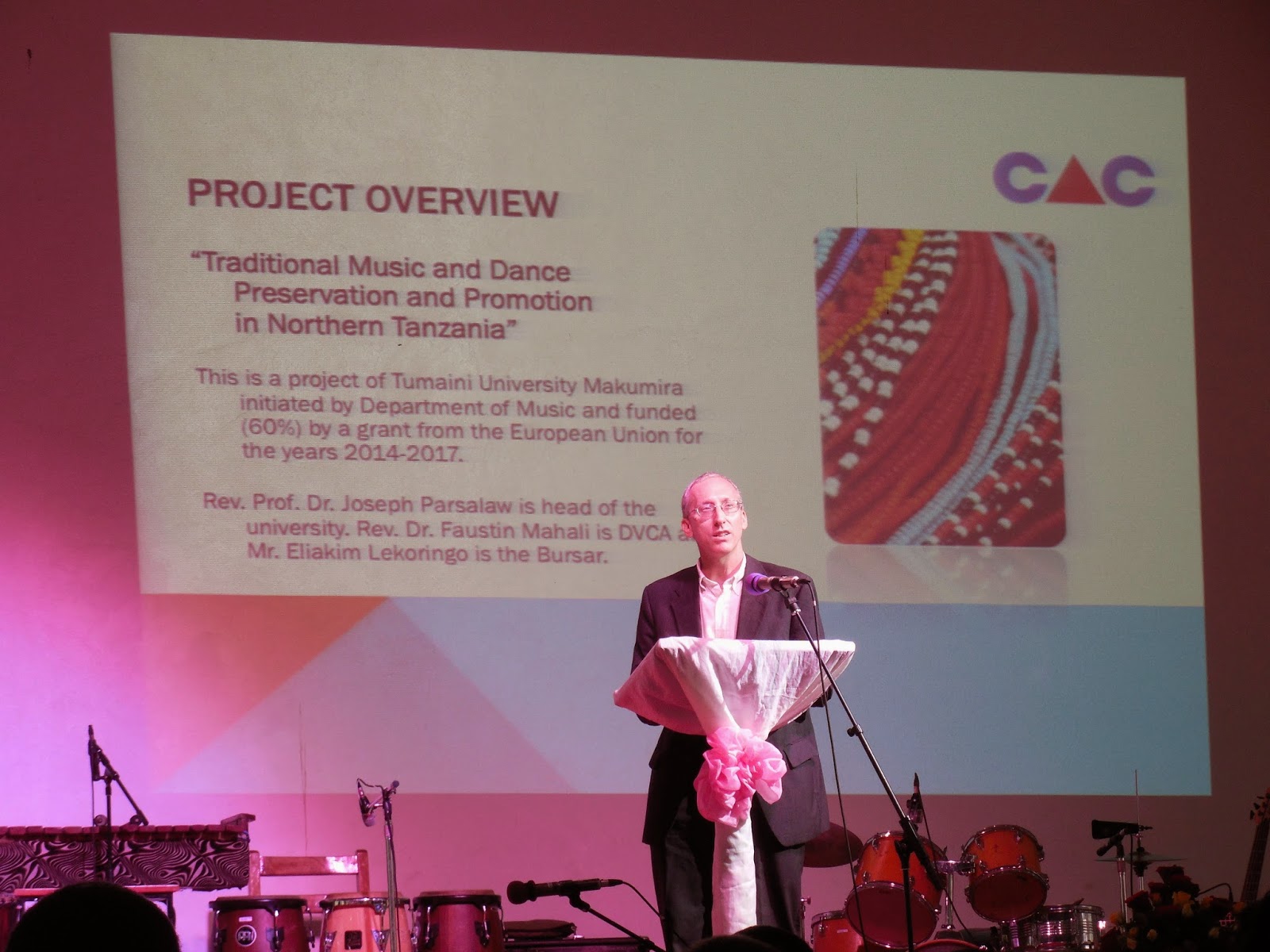
Inauguration of the Cultural Arts Centre


Randy Stubbs presenting the new Cultural Arts Centre
I was so pleased to be able to attend the inauguration of the Cultural Arts Centre at Makumira University last Friday. What an inspiring event and they have only just begun! Randy Stubbs has worked tirelessly against multiple substantial challenges to get this project off the ground, and the presentations reflected the impact this centre has and will have. It was great to see the finished extension of the university assembly hall complete with new lighting and sound systems, as well as the nearby site where the new arts centre building will be constructed. These facilities are among the best you will find in East Africa. 

The project has been funded by the European Union Development Fund, and has two partners; Alliance Franco-Tanzanienne and the Kilimanjaro Film Institute. AFT are helping out with training in project management and entrepreneurship, and KFI are assisting in documenting field research in traditional music. In attendance at the ceremony were various university and church leaders, a representative for the EU ambassador, and the Executive Secretary of BASATA (the National Arts Council I mentioned in my last post). The centre will primarily be an archive of the cultural heritage of Northern Tanzania, as well as a performing space for cultural performances for tourists.

The performers who will be undertaking regular cultural performances as well as outreach workshops are in the middle of a month's intensive training before they are reduced from 30 to a team of 15. The amazing versatility of the musician-dancers was a treat to watch - they performed snapshots of traditional dances from various people groups of Northern Tanzania, as well as more contemporary Tanzanian music. The interaction of traditional rural and contemporary urban styles was fascinating and inspiring for me as I try to imagine a music curriculum for students, in the same context, that allows them to be cultural ambassadors and global citizens. Looking forward to the future of culture in Arusha!

Masaai


Wagogo

Swahili Jazz

Masaai rap!


New lighting system in the assembly hall

Tuesday, May 12, 2015

Music Policy Landscape of Kenya and Tanzania

I have just discovered the new National Music Policy of Kenya that was published at the beginning of this year and it got me thinking about music at a policy level in Tanzania also. The policy is immensely broad and encompasses all aspects of the music industry and education in Kenya. It highlights the many gaps and challenges existing and calls for the beginnings of many new, substantial initiatives and institutions such as the National Music Board and Tribunal. 


Whilst the Kenyan Constitution mentions the protection and promotion of music, there is little other legislation relating to music or organisations supporting musicians such as trade unions or professional associations. Yet it is estimated that over 100,000 people are employed in some way in the music industry.

The two policy objectives I am particularly interested in are:
iii) To spearhead the preservation and development of indigenous music as well as other music genres;
iv) To support the process of music education and training at all levels;

The use of music to express national identity and for tourism features as one way to preserve Kenyan traditional music, and it is interesting how the strategies they wish to adopt are similar to what the Cultural Arts Centre is following with music from Northern Tanzania. 

Music Education features in other education policy documents but it is great that a distinct National Music Education policy has been called for. Also it will be fascinating to see what "an academy for the teaching and learning of music in its diverse cultures" looks like in a Kenyan context if it materialises! Again they will only need to look to the Makumira Music Department for ample inspiration...

They intend to fund this all through the new Music Industry Development Fund - good luck to them!

As far as I can find out, Tanzania has an Education Policy and a Cultural Policy but no specific Music policy. Music is no longer seen as distinct in policymaking - in 1974 a National Music Council was formed, and ten years later this became the National Arts Council (BASATA) to include dramatic arts. I couldn't get on to their website (does it still exist?!) but I found this YouTube video of the Executive Secretary saying nothing much.


Tanzania seems to be ahead of Kenya in having already established important institutions within the music sector. There was a musicians union (CHAMADUTA) that was started in the 80s, and this may have been continued by the Tanzania Musicians Network with an English site found here. A group of artists went to Dodoma to call for the recognition of artists and Intellectual Property Rights in the new Tanzanian Constitution (Katiba) which will be voted on this year. Tanzania already has a Cultural Fund (Mfuko wa Utamaduni) developed in 1998 alongside the Swedish government to promote and strengthen the cultural sector in Tanzania. Between 1999 and 2005 it provided grants for 302 cultural projects, but the website has not been updated since... The Copyright Society of Tanzania (COSOTA) was set up in 1999 and seems to be pretty active.

Interestingly, since the end of colonial rule in 1961, musical genres influenced by Tanzanian traditional music such as 'modernised ngoma' and 'Swahili jazz' has had more media coverage than its counterparts in Kenya. Due to the government policy of encouraging a national music, the main broadcaster for the 1960s through to the millenium, Radio Tanzania, either had a 100% Tanzanian or a 50% Tanzanian, 45% African music policy. Kenya has had much more influence from Western classical music with organisations such as the Nairobi Music Society and the Kenya Conservatoire.This may explain why Tanzania established institutions relating to musicians in the 70s and 80s but unfortunately it seems that momentum wasn't sustained.


Wednesday, April 29, 2015

One month to go at the Pastoral Women's Council

Sponsored girls at Emanyata School, managed by PWC
Time has gone super fast since I wrote on my first month's experience at PWC. The pace hasn't really let up at all but I'm grateful for the experience in so many areas of programme management; establishing HR systems, recruiting, creating a fundraising strategy, writing proposals, donor reports, the Annual Narrative Report, organisational strategy and generally trying to get the PWC documents I inherited into a more workable system.

We moved the office at the end of February from town to a much quieter, more pleasant area near to the airport. We now have a mama who makes delicious lunches (beans and rice, pilau) and the caretaker Lucas makes the morning chai and is generally fabulous. He and his family live next door and they are also Masaai but from Monduli district which is closer to Arusha (PWC mostly works in Loliondo and Longido districts).

A highlight for me has been the recruitment of a new sponsorship officer. Lucia is from the village where Emanyata school is based, and was herself sponsored to go to MaaSae Girls secondary school in Monduli. This school was established by the father of some friends from church and has just celebrated 20 years. She later went on to complete her sixth form studies at another school in Arusha and then  an undergraduate degree in Community Development. She is passionate about girls receiving the same opportunities she did, and I'm confident the sponsorship programme will flourish under her direction. PWC is receiving more sponsorships from individual donors, and a challenge for the future will be more personalised communications between sponsor and student.  Lucia and I also enjoyed a visit to AfricAid who work with sponsored girls but in a different way: http://www.africaid.com/kisaproject The Kisa Project Director was also a sponsored girl who went to school with Lucia - another wonderful result of girls sponsorship!

A definite lowlight these past few months was discovering that there was no editable copy of the constitution for the process of amendment to add an important new article. This involved typing all 18 pages out from scratch. I'm pretty familiar with the organisation now..

Now I'm at the final countdown to handing over to the new Programme Manager, after which I'm free to head home to the UK! It will be sad to say goodbye to my colleagues and to not be directly involved in such a great grassroots organisation, but looking forward to the next challenge!

Monday, February 23, 2015

El Sistema Fellow Teacher Training course

  An example of what we need more of!:
 
Master of Arts in Teaching Music
a partnership of JAMM, the Juneau Symphony and University of Alaska Southeast
                                   
OVERVIEW: 
In partnership with Juneau Alaska Music Matters (JAMM) and the Juneau Symphony (JS), the University of Alaska Southeast proudly announces its one-year Master of Arts in Teaching (MAT) Music K-12 certification program to reflect the changing role of today’s music teacher.  As part of the course requirements, MAT students will conduct their teaching internships at JAMM school sites and music classrooms within the Juneau School District, as well as perform in the Juneau Symphony. This  program gives preference to musicians interested in using music for social change. 
Through a competitive application process, up to four $10,000 scholarship are available to music majors/minors whose main instrument is violin, viola, cello, or bass.  MAT graduates are awarded a Master’s degree in Education with an Alaskan teaching certificate in K-12 Music.  Program begins July 26, 2015
Application Deadline:  April 1, 2015 (letter of intent for consideration of scholarship is March 1, 2015)
Living in Juneau, Alaska:  Located in Juneau, Alaska, this artistic community is surrounded by natural beauty and provides an idyllic environment to pursue a graduate degree focused on community engagement, positive youth development, and social change through the arts.  Accessible only by boat or plane, Alaska’s capital supports a symphony, two opera companies, several theatre companies, and a host of other arts opportunities throughout the community.  In 2013, Juneau was selected by the John F. Kennedy Center as the 11th city in the country for its Any Given Child program, an initiative committed to bringing equity and access to arts education for children in grades K-8.  
Interning at Juneau Alaska Music Matters (JAMM): All MAT students will conduct their 9-month internship with JAMM, an El Sistema-inspired program, which uses the power of music and ensemble to help children reach their fullest potential.  JAMM serves 500 students in three elementary schools in the Juneau School District.  Lorrie Heagy will serve as the mentor teacher.  She is the 2011 Alaska Teacher of the Year, school music teacher, and one of fifty Sistema Fellows who studied at the New England Conservatory and in Venezuela to bring Sistema’s transformative approach to the United States.  In addition to general music classes and after-school JAMM programming, MAT students also will gain experiences in classes at the the middle and high school level. 
Quartet-in-Residence: JAMM and the Juneau Symphony, along with other key community stakeholders, will sponsor a Quartet-in-Residence by providing a $10,000 scholarship to four music majors/minors who play a stringed instrument:  violin, viola, cello, or bass.  The quartet will inspire JAMM students, as well as contribute to Juneau’s classical music community and teaching artist pool, while increasing teachers credentialed to work in the K-12 music classroom. 
Aligning the MAT Music (K-12) Certification with the Transformative Role of Today’s Music Teacher:
The role of the music teacher has changed. Music teachers are agents of change, where instrumental music serves as a critical opportunity for all children to have access to the social, emotional, and intellectual benefits that music provides.  The MAT Certification in K-12 Music provides its students coursework that prepares them for their multi-faceted role in today’s society:  as citizen, artist, teachers, and scholar. 
COMPONENTS OF THE MAT MUSIC (K-12) DEGREE PROGRAM:
Brain-based Teaching Practices:    
Students will participate in Juneau’s Basic Arts Institute, where participants learn skills that will enable them to apply brain research into their classroom practice and learn first-hand knowledge of how the arts increase student engagement and achievement.  Participants will work with experts, local artists and cultural leaders to explore a variety of arts activities that they can use to integrate the performing, visual, cultural, and media arts into their curriculum.
Rehearsing and Performing with the Juneau Symphony: 
This course mutually benefits the Quartet-in-Residence, as well as the Juneau Symphony. By rehearsing and performing with the Juneau Symphony for its concert series, MAT students maintain their performance skills, while by actively engaging and contributing to Juneau’s musical community 
Emphasis on Positive Youth Development:
Students will apply Lerner’s Positive Youth Development model, as well as other educational theories that emphasize student empowerment, self-determination, efficacy, and resiliency.  Educational theorists such as Freire, Dewey, Bandura, and Dweck provide different lenses in which to understand and support a child’s cognitive, social, and emotional growth. 
Overview of Music Pedagogies and Music Technology Applications: 
Students will actively participate in and teach lessons demonstrating key principles from Dalcroze, Orff, Kodaly, Suzuki, Feierabend, and World Music Drumming.  The lessons also include brain-based teaching strategies that help motivate, engage, and empower students.  Other components of this technology course include GarageBand to create music, Finale to make simplified arrangements, and Web 2.0 tools to document learning as part of a professional educational portfolio. 
Classroom Management:
Although well-structured, developmentally appropriate, and engaging lessons often preclude behavioral issues, today’s music teacher faces challenges different from those of the regular classroom teacher.  Oftentimes, music teachers are tasked with teaching ensembles of fifty students or more (each with and instrument in hand) and  no other adult support.  Place this situation in an after-school context and classroom management can become even more challenging.  To equip MAT students with a more comprehensive tool kit, the internship provides students with an overview of effective classroom approaches, including the Responsive Classroom, Love and Logic, and Michael Grinder’s ENVoY.
Educational Research:   
The MAT K-12 Music Certification program embodies the scholar-practitioner model, which helps students apply new knowledge through action and civic engagement. As part of this research class, students will create and apply new knowledge to effect social change in their school and community.  Grant writing has become a necessity and required skill of today’s music teacher. Students will work alongside JAMM music teachers to identify a research project that will contribute meaningful data toward student outcomes, program effectiveness, or community engagement.  MAT students will incorporate this data into a grant application that they’ve identified and written to help support JAMM.    
Electronic Portfolio:
Throughout the MAT K-12 Music Certification program, students will document their work as citizens, artists, teachers, and scholars. By including rich media as part of their portfolios, UAS students not only will be contributing to the wider community, but also providing future employers evidence of their work. 
For more information contact: 
Scott Christian srchristian@uas.alaska.edu  (907) 796-6563
Lorrie Heagy heagyl@gmail.com      


Stagnation leading to Toxification

Negativity and humiliation = excellence in music education?

The above link is to an article showing the most extreme side of music education. It warns us again what can be produced by the toxic music education culture prevalent in many schools and higher education, and which extends into professional music culture.We have all experienced this to some degree.

Music education has avoided the rigorous assessment and evaluation processes that has reformed and developed education in other disciplines, mostly because it still predominantly exists in the domain of private education. It's quite staggering to think how little music education has developed - having church choirs operating the same way they did in the Middle Ages is not necessarily a good thing.

The music education world, and the classical music world in particular, needs to do away with the following:
  • Perpetuation of the 'Talent' myth
  • Idolization of prodigies and maestros
  • Idolization of 'dead, white blokes' and the fixed concept of a 'one true way' to perform their music
  • Elitism and maintaining music education in a silo separate from other disciplines
  • Unhealthy focus on technique to the detriment of fostering musicality
  • A total lack of interest in considering audiences
  • A hierarchy of 'most talented' musicians from conductor, soloist down to teacher - Those who are not a professional soloist have not 'made it' and have made to feel that they have failed
  • The dismissal of the potential of music as an integral part of how a community functions and how we serve each other
You can read lots of similar thoughts in Music, Talent and Performance: A Conservatory Cultural System.

Although admittedly El Sistema in Venezuela does not avoid all of the above, it is so refreshing how it demands us to ask questions of our music education contexts. Many El Sistema-inspired programs are approaching things in a very different way - but we must be careful not to replace some of the above with Venezuelan celebrities. The more music education programs become accessible to the wider community, the more accountable and progressive they will have to be. Teaching and learning methods will have to be based on solid academic research and brain science rather than the possession of a performance diploma or degree. Teachers will have to be engaged in reflective practice rather than replicating from experience at a conservatory. Much of this is starting to happen and we need more!

Tuesday, February 10, 2015

One month at the Pastoral Women's Council


My first month as co-programme manager at the Pastoral Women's Council has been hectic to say the least. Whilst the projects themselves operate in Loliondo, Longido and Monduli (North Masaailand in general), I have been working at the Arusha office. Here I spend my time with my co-manager, two finance assistants and the executive director when she is not in the field.

I've been plunged into the season of reporting and fundraising - luckily the reports are almost over, and we've had renewed committments from donors to sponsor masaai girls at secondary school and higher education. Also the beginning of the year has seen the renewal of staff contracts and other HR fun and games. Right now, the rest of the management team are getting ready for the annual staff meeting, General Assembly and the first board meeting of the year, which will be in Loliondo. Phew!

Learning about the organisation and all the projects they run has obviously been a necessity, along with how best to communicate with staff across three districts. I still have so much to learn but these have been the most important things so far:

  • Girls sponsorship at secondary school is the most effective way of preventing forced early marriages and pregnancies.
  • I did not previously know about the tradition of 'esoto' - night time dances with Masaai warriors and girls that ends up in unwanted pregnancies.
  • Its a dilemma to encourage girls (and boys) to finish their education when the schools are of such low quality; corporal punishment is rife, teachers are ill-trained and often don't bother showing up to lessons, and the curriculum is pre-Victorian.
  •  Land rights cases can be postponed for over six months at a time and subsequently can continue for years.
  • There is a bewildering array of various mechanisms of local government, some of which are taking on the responsibilities of their community e.g. sponsoring girls' education, and funding the process of women receiving land titles.
  • Nursery schools that don't receive any funding from the government are trying to sustain themselves through livestock businesses.
On to month no. 2...


The Middle Ground

I have just finished reading the inspiring story of missionary pilot Nate Saint in the book ‘Jungle Pilot’. One of the first MAF pilots in the 1940s and 50s, Saint was a pioneer in the true sense of the word; he built airstrips, flew into areas never accessed by plane before, designed bucket drops to deliver parcels without landing, vastly improved the safety of small aircraft that has a continued legacy in missionary aircraft, and built houses, a hangar, mission hospital and school. His most famous legacy was being part of the team of missionaries who established contact with the notoriously violent Waodani people; all five men were martyred in the process.


Many have been inspired by stories of pioneers in whatever field of mission and development they are working in, but the next generations require different approaches in their more developed and urban contexts. Nate's son Stephen writes an epilogue in our edition where he talks about the challenges of establishing services run by and for the Waodani people, who Nate was contacting when he died.
I have been thinking about putting approaches to development into four categories; Emergency relief, short, medium and long term. Many development organisations, and the wider public, are familiar with the approaches required for the first two; we raise money for disaster relief, and ship out huge amounts of second-hand resources, we build schools, hospitals and dig wells. This has been going on for over a hundred years.

Medium term approaches have been more recent; sponsoring children to go to school, micro-enterprise and micro-credit. In the West, we are getting more used to buying products from these enterprises and even funding small loans for business start-ups (www.kiva.com). I have found that there is not much of a continuum from the short term still; training the teachers and management at the schools and hospitals that have been built, and facilitating the maintenance of wells in rural villages. Likewise, many of these small businesses or NGOs that offer training in a variety of skills and crafts are still run by expats, the products are designed according to western styles, and their markets abroad and access is facilitated by volunteers. Without adressing these issues, the short term solution has had little impact.

How do we as development organisations continue to make an impact in this middle ground? By building on existing infrastructure, by adding to and working within the infrastructure, by training those who are running social services and advocating for their contributions to providing those services outside of urban areas. This is the medium term approach with the aim of reaching long term goals of independence, sustainability, accountability and ownership.

In the Ngorongoro Conservation Area, the Pastoral Women’s Council has been working with the Pastoral and the District Councils to advocate for support for pastoralist girls’ education. As a result, these institutions are taking on education as a priority in their strategies, are sponsoring girls to go to school and are establishing a Pre Form 1 centre to support the transition from primary to secondary school. These projects are starting to change community attitudes towards education for girls, and making long lasting changes within the existing infrastructure. Much more needs to be done, and I feel there should be more dialogue around successful partnerships with government institutions and how we can best support them.

Many organisations also do not have an exit strategy. If there is no thinking behind making your operations defunct and unnecessary, there is no commitment to making long term changes. Instead we create further reliance on the support we deliver. It’s very hard to imagine yourself or an organisation being useless, and too many NGOs thrive on the notion of being needed, and in fact use that as a ‘selling point’ for support. We need to more accurately map out the landscape of the middle ground to consider a future where services are locally provided and sustained.


Monday, December 1, 2014

Return to the Pastoral Women's Council


So tomorrow I go back to the Assistant Programme Manager job for the Pastoral Women's Council. Three months of reporting, fundraising and helping to find someone to take over the position permanently in March. I hope this will be more great management experience as well as getting to grips with how an NGO works here. All good for when more musical opportunities come my way...

Tuesday, November 25, 2014

The Pied Piper of Haydom

Lena Ward - Haydom Lutheran Hospital
 
It has been my great fortune to visit this hospital for a week every month for the last four months. Whilst Kirstein flies nurses and chanjo (vaccines) to remote villages in the area, I have been enjoying a kind of retreat; writing, researching and getting to know some of the people who are dedicating their time and expertise to this astonishing hospital. I was lucky enough to get a detailed tour of the hospital on my first visit, as it coincided with a visitor from a nearby health clinic who was eager to see if their patients could be referred here.
 
A friend suggested that I should take my violin to play for the patients, so on this last visit I managed to play for the children and their relatives. They have visiting hours between 2-4pm; the first afternoon I played in the main room where they have parties on weekends, and the second time I played in each room. A wonderful nurse called Sister Paulina was my escort to the different rooms and joined in singing with me as I played Swahili hymns and Christmas carols. It was great to hear relatives joining in (mostly the mamas) and clapping along.
 
There has been a lot of debate in the media recently about the well-intentioned Sir Bob and the re-release of 'Do they know its Christmas?' to raise money for the ebola crisis. It's hard to believe that the same tales of the woes of Africa are still being thrown out today - that the West hasn't moved on in their misconceptions and misjudgements after 30 years. Yes, the ebola crisis is horrific and requires external help, but it is only the crises that demand money that ever reach the wider attention of the West. I want to focus on the assets and the potential. The children and families in the Lena ward are receiving good care, they most definitely know it will soon be Christmas, and they most likely have a better idea of the true meaning of Christmas than their counterparts in the West. Mungu awabariki! 


Monday, November 17, 2014

Ignition!

I have just finished reading Daniel Coyle’s The Talent Code, and I was especially interested in his idea of there being, in the learning journey, points of igniting desire to commit to deep practice of skills – Coyle says that along with master coaching this leads to being an expert of whichever discipline is involved. This ignition could also be termed as intrinsic motivation. We used this term a lot in our discussions and writing during the Fellowship, but we didn’t have time to really unpack what it means.

Coyle cites the following factors as tinderboxes waiting to ignite a passion for ‘deep practice’:
1) Having an expectation and understanding of commitment involved: Gary McPherson studied students new to music in 1997:
“We instinctively think of each new student as a blank slate, but the ideas they bring to that first lesson are probably far more important than anything a teacher can do, or any amount of practice. It’s all about their perception of self. At some point very early on they had a crystallizing experience that brings the idea to the fore that says, I am a musician. That idea is like a snowball rolling downhill”.
2) Role models
3) Sense of belonging to a group 
4) Sense of danger or lack of safety - dissatisfaction leads to efforts to change our situation or the pressure of impending accountability such as a concert or exam
5) Being the underdog
6) Praise of effort rather than achievement
Daniel Pink is his book Drive adds the following:
7) Autonomy – Being able to choose your own direction
8) Mastery – Satisfaction of getting better at something 
9) Purpose - this could be personal “I want to be the first person who goes to college in my family” or seeking a change in the lives of others “I empathise with this person’s situation and I want to do something to help”.
I’m writing this at a Lutheran missionary hospital in Tanzania. As the hospital approaches its 60th anniversary, you can’t help but consider the ‘deep practice’ of Norwegian missionaries who built the best equipped hospital in the country, in the middle of the bush, surmounting cultural, logistical, geographical, financial and linguistic barriers, and who have sponsored children from primary school age to have them return to the hospital as surgeons. I’m not sure you could even grasp a sense of the commitment that would be needed from those early years to now, although there was and is a sense of danger in terms of providing decent medical services to a catchment area of 2 million people. It is their sense of purpose that has ignited their commitment and perseverance in this task.

I have one more point to add:
10) Personal relevancy – searching and learning about yourself leads to personal satisfaction, relaxation and often emotional and spiritual uplifting.


The El Sistema program in Venezuela has been able to create a culture that ignites many of the above:
1) Understanding of expectations - Students see the progression from paper violins to to youth orchestra level in the nucleo and the daily commitment to the program.

2) Role models - Along with the inspiring figure of Dr Abreu, Dudamel is the hero of many musicians in Venezuela.

3) Sense of belonging - Students go through their years in the nucleo belonging to the ensemble, and the Venezuela jacket is their uniform showing that they belong to a greater group of the Venezuelan people.

4) Sense of danger  - not just a feeling of unease on the streets of Caracas, but that the music education available to them at the nucleos is not found elsewhere and is therefore to be treasured and appreciated. Some facilities are barely suitable for their purpose but they soldier on regardless. Students are also prepared for a performance shortly after starting to play their instrument.

5) Underdog – Venezuela has no strong history of classical ensembles or a place in the classical world compared to the cultural bastions of Europe and the US.

6) Tochar y luchar – 'fight and play' rather than you’ve either got the X factor or not.

7) Autonomy - One aspect of motivation that El Sistema may not be encouraging; there doesn’t seem to be much choice of instrument and repertoire, and there is lack of opportunities to study other musical disciplines such as composition and improvisation. There also doesn’t seem to be much flexibility in terms of how much you want to commit to the program, the daily rigorous rehearsals and regular performances, and there is not uniform access to auditions, more advanced ensembles and touring opportunities throughout the country.

8) Mastery - Many El Sistema commentators remark on the sheer brilliance of students, the joy apparent in performances and how many hours they are willing to commit to practice. Being invited to take over the Salzburg Festival must say something about the excellence of the musicians in the program.

9) Purpose - The corporate mission that music belongs to the community and exists to serve others.

10) Personal relevancy - Eric Booth: "El Sistema conductors and teachers invest far more instructional time in describing sections in terms of stories, or giving visceral images for a note or a phrase, than do traditional conductors. This enables the musicians to make stronger emotional and physical connections to the music. This investment in emotional connection fuels the Sistema teaching truth that “passion provokes precision”—meaning that a young artist’s emotional investment leads to mastery more reliably over the long haul than technical drill; indeed, the hunger to express more fully drives the improvement and creates motivation for technical solutions more than compliance or a generalized hunger for improvement."

Maybe the fact that El Sistema reaches 9 out of 10 'ignition' points explains why so many people devote their time to the program, both in and out of Venezuela. 

Thursday, November 6, 2014

Uraki Secondary School


Last week, I went to visit the music program at a government school on the other side of town. Uraki has had a link with Makumira University Music Department for two years now, and three students and an university tutor deliver classes there every other day. The school is a secondary school with students in Form I-IV and roughly ages 11 to 16 years. At the end of Form IV they take their O-Level exams, and like most secondary schools in Tanzania, there is no provision to progress to A-Level.

In fact, they are now in the midst of the end of year exams and many students were busy cleaning the classrooms ready for exam week, and even the District Educational Officer was visiting. She was especially interested in the science laboratory which had been equipped with donations from the UK, and another lab was also being constructed. As part of the Secondary Education Development Plan, the government has ordered that each secondary school build a laboratory, without providing the resources to do so.

We had a chat first with the Headmaster who is very eager to have musical provision in the school. The music students are hoping to give a music class for the teachers, but they had already left the school leaving just a few staff around including the Teacher On Duty who walks around with a stick!

The bell was rung for assembly, and all the students lined up in their separate forms with different colour jumpers for each form. I introduced myself and then the students were given the choice to clean or take part in a music activity. The session I saw was interesting - they didn't seem quite into learning new material at this point in the afternoon, and some just walked away. However, at the end, they sang a well-known song from their early music classes (see video above) and were having a great time.

In addition to the practical ensemble classes, the students are receiving music theory lessons which enables them to take the predominantly theoretical national exams in music (NECTA). Throughout the school, pass rates are very low, but they are started to excel in their music exams. The university tutor remarked that their goal is to show how music can change a school, and with the best pass marks in music, the students can begin to gain a sense of what they can achieve!

Tuesday, November 4, 2014

Music For One Foundation


A couple of months ago I met up with the second cohort of musicians from the South Korean organisation Music For One Foundation. The Foundation describes itself as "a performing arts-based humanitarian organisation dedicated to working with children and their communities worldwide to reach their full potential through music and music education". There are many programs that make up the organisation but volunteers Stacy, Kris and Chanmi are part of the Gift of Music Program which seeks to deliver music education to communities in less developed countries.

Their program has funding from the Korean government for three years and they are teaching at a university music department, a Lutheran Bible school and a children's centre with 300 primary aged children. Let's hope it can continue!


SFRC Reception

The next two years on the Sistema journey! The formal transition of the Sistema Fellows Program to the Sistema Fellows Resource Center occurred yesterday at the New England Conservatory. I so look forward to joining my fellow alumni making music with youth across the world when my project starts soon...


Go to this link to find the final report on the Sistema Fellows Program:
http://necmusic.edu/sistema

Friday, October 24, 2014

Marching off the map


At a sermon at my church in Arusha, a Lutheran pastor told us this story: When a battalion of Roman soldiers were about to march into territory that hadn’t been recorded yet, they sent a messenger back to Rome to report that they were about to march off the map. At the moment, in the midst of planning, conceptualising and researching, I feel a lot like these soldiers - and I’m also looking out for a battalion to join me!

A lot of what I aim to do has definitely already been charted, or is in the early sketches; a music project using traditional music, an El Sistema-inspired program, cross-cultural and interdisciplinary performances, community engagement across cultural and linguistic boundaries. However, there is a long way to go for these landscapes to be fully explored.

For example, Sistema-inspired programs are mostly using classical and western folk music and without much consideration of the students’ and community’s cultural background. The traditional ensemble set-ups of the orchestra and choir are used as paradigms for teamwork, co-operation and the cultivation of empathy – Daniel Barenboim’s “template for democracy”. There are few models of using other genres of music in intensive programming for social outcomes. Likewise, they all offer free music instruction and so rely on tempting donors with easy-on-the-eye statistics about the grade improvements of students involved in their programs. There is a desperate need for these programs to develop some sort of self-sustainability and to advocate for more community responsibility for the program, and especially for the programs in the context of developing countries.

In the West, we have an obsession with specialisation, becoming an expert in one skill or field. This has resulted in the delineation of a myriad of genres and styles of art, and an ensuing hierarchy, so that ‘crossover’ between different genres of music is generally not encouraged. In the world of education, examination boards create qualifications that put up barriers between rigidly defined artistic expressions, although this is starting to change with newer multi-disciplinary qualifications such as BTEC gaining as much credibility as the A-Level. If cross-pollination between different genres of one art-form is rare, consider how infrequently cross-arts exhibits or performances are supported in schools. By contrast, in Kiswahili there is one word for a community performance of various musical expressions ‘ngoma’, and one word for the arts ‘sanaa’.

Another landscape that I really get excited about exploring is that of the artistic performance experience. Being trained in the world of classical music, I have a set of rituals and etiquette wired into my performing system. In our contemporary urban societies, however, we consume culture and the arts at a fast pace with multi-sensory experiences and interactions that are incompatible with the concert hall culture. So what can these new culturally and community relevant performances look like?  

One landscape that gives me a headache thinking about is that of how to evaluate artistic quality. For many in the mainstream music world, quality means a high level of individual proficiency on an instrument, such as a prodigious display on the violin or piano, or an ensemble executing a complex technical piece. For others it means a close imitation of recorded artists; their sound and style of musical expression, their arrangement of a known song. These criteria for quality reflect the individual and isolated life of a musician seeking a place in a competitive performance world. This lens would not be appropriate for assessing the quality of a master drummer leading a drumming workshop at a community venue, or the performance of a traditional dance troupe.

Lastly, there is the balance and synergy of artistic and social aims in community music programs. Social change through music can be interpreted in a myriad of ways. Two versions that I have been considering involve using music as a support for educational attainment or learning outcomes, and for community-building or strengthening social cohesion. For the first version, Sistema-inspired programs are beginning to accumulate data about how intensive music programs affect achievement at school and there is a growing pile of awesome brain science as to how the process of learning music supports other learning. The field of community music and El Sistema in Venezuela answers to the second version, but where does the artist focus on the quality of the artistic product and where do they focus on the quality of community engagement and social impact?

Peter Renshaw has this to say about one music program in the UK: “But the work of Music in Prisons also has a social aim – basically, to stop people re-offending. Music is then seen as a vehicle for achieving social ends – but the music leader is not an artistic ‘social worker’ or therapist”. In other words, musicians can and should find a place for themselves in community contexts but remember that they are first and foremost musicians. At a workshop the Fellows attended at Dreamyard in the Bronx, NYC, one teaching artist talked about how the arts succeeds in bringing the community together and strengthening bonds so there is more potential for community support. This view sees the arts as establishing and supporting bridges between community members.

So not only should we march off the map and explore new territory, but we should use our artistic expertise to build foundations and use the materials available in the community to construct bridges. What this will look like is waiting to be discovered.

Thursday, September 11, 2014

The Simon Bolivar Project


The Simon Bolivar Project in essence is to expand the El Sistema program to reach 1 million students by the year 2019. As noted in various articles (http://nsnbc.me/2013/05/23/venezuela-to-expand-its-el-sistema-music-program/) the project will be funded by the President's Office. 

Roderigo gave us more information about the methods being used to reach the goal of 1 million:

·         El Sistema will continue to lobby community leaders to get permission to start programs, and knock on doors in barrios to invite families to be involved. They receive continued requests from communities as well to have El Sistema work with their children.

·         The program will speed up its de-centralisation process in order to reach the required number of children. Currently audition opportunities, instruments and other resources are difficult to get outside Caracas, and there are not many opportunities to play in Caracas or tour nationally. There needs to be a stronger bridge between the two worlds of El Sistema – the ‘elite’ and ‘rural’ nucleos by supporting and mentoring teachers sent to rural nucleos.

·         El Sistema will build on the government-led Bolivarian school scheme as a way of working with the public schools and including them as part of the project. The school day usually ends at 1pm, but this is extended to 5pm so the schools essentially become nucleos. Parents already pay a lot for childcare during this time so this would also greatly benefit families. The scheme is 6 years old and currently involves art and sports activities. El Sistema was initially consulted by the government because of the organisation’s long experience dealing with large amounts of children in arts activities. There has been Presidential approval for El Sistema to take on this scheme as part of the project along with the access to funding, resources and facilities that are part of the scheme.

·         The program needs to triple the amount of staff (including allowing existing teachers to get certification) and to create foundations to allocate funds. Lots of institutional development needs to occur – there has been much expansion vertically but now El Sistema needs to expand its base to create opportunities for all regardless of location.

·         The Special Needs Department at Barquisimeto aims to create a pilot program in state schools and then replicate the model at other schools.

We heard lots of variance in numbers of how many students are currently in the program and how many each area was aiming to get on board. At some points it sounded like a race to get as many numbers in the program as possible, regardless of the quality of musical engagement. We talked we some nucleo directors about their strategy to reach this goal.

Jesus – Nucleo Director at Merida

Jesus is convinced that the project will be successful due to Dr Abreu’s visionary leadership; “There are those who doubt his huge plans but when you speak to him, he makes them sound plausible, he convinces people as a musician and an economist.” He pointed out the reputation and celebrity surrounding El Sistema, Dudamel and the program’s global renown; “Everyone wants to be part of El Sistema - the real revolution!”  Families are inspired by the achievements of their neighbours and they realise that background isn’t an issue. According to Jesus, this year the whole of El Sistema wants to recruit 120,000 more kids (he thinks a more realistic figure of how many in the program now is 390,000).

Merida’s strategy this year is to extend to six new schools and 6000 more students, which has been made more possible with the new cable car from the town centre to the barrios. It is impossible to expand the existing nucleos as they are already too full, so they will work with the schools first and then open another nucleo. They started in November 2013 with choir and recorders; students share instruments, there is a carousel of classes, and the program also sells violins to students (the cheapest are 5,000 Bolivares).They aim to present these new students’ performances and then get money for orchestral instruments from regional and local governments. Jesus spoke about issues with getting the directors at the state schools on board with the program, but not with the students and their parents. They eventually want to get 20,000 children in the whole state involved.

Victor – Nucleo Director in Ejido, Merida State

Victor worked in the nucleo development office in Caracas. His area goal for 2019 is to expand the number of children served from 487 to 3325. Within four days, they set up 25 small music centres of 1,300 students in the barrios in the area (modulos) with only one teacher for singing, cuatro and theory. An issue is to get motivated teachers for the modulos who are willing to adapt to the school environment and the facilities available. When asked about the pace of the project, he replied; “It’s going quickly because it is working! When a Venezuelan has an idea, you just do it.”

From his experience in Caracas, he told us how the culture of the new students is the most challenging aspect of nucleo development, as they come from very difficult and dangerous backgrounds. He was involved in going from house to house with teachers to invite people to the project. They even talked to the ‘mafia’ about bringing culture to the barrios, and persuaded them to leave the program alone and protect them.

It will be interesting to see how the dynamics of the El Sistema program adapt to working in schools, considering that many Sistema-inspired programs are in-school or after-school programs. The success of this project will undoubtedly continue the program’s ever-increasing global influence.